Home workouts: how to build an effective program
6 min read
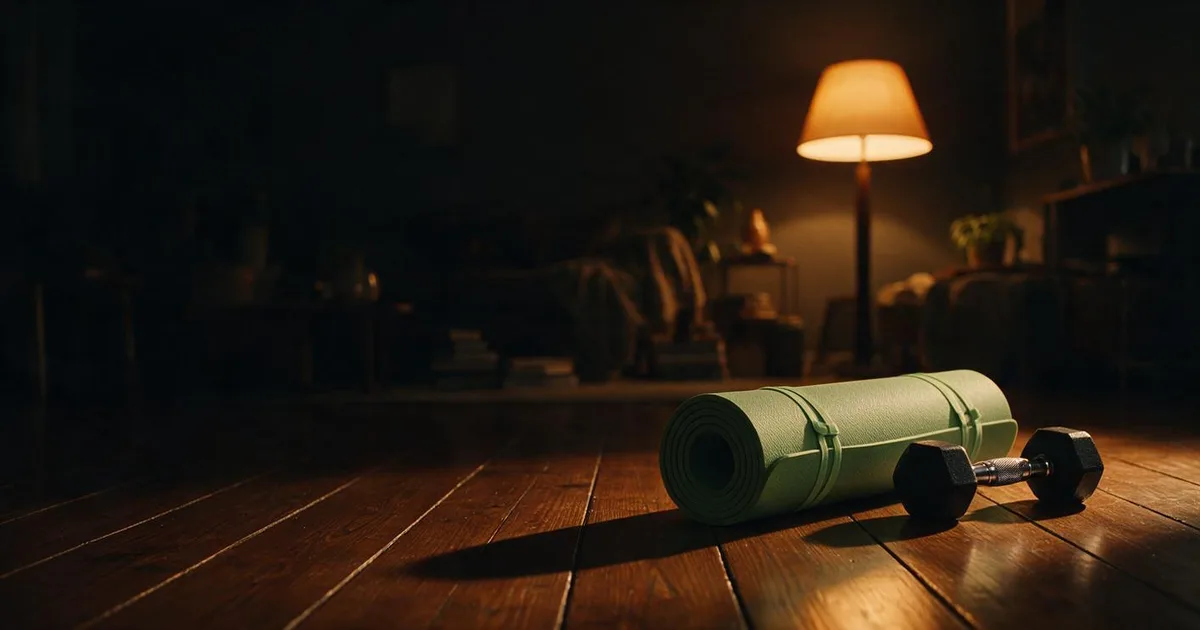
A home workout can work very well, but it needs the same thing a gym program needs: structure. Random circuits make you tired; a program makes you better. The goal is to train the main movement patterns, repeat them often enough, and progress the difficulty over time. Below is how to do that with whatever equipment you have, which purchases pay off and in what order, how to keep the load rising without machines, and how to handle the two places where home training usually falls short: the back and the legs.
Start with the equipment you have
No equipment? Build around squats, lunges, push-ups, hip hinges and core work, plus rows with a resistance band. Have dumbbells or bands? Add goblet squats, Romanian deadlifts, shoulder presses, rows and curls. The best home plan uses what you can repeat consistently. What matters is not how much equipment you own but that every main movement pattern has at least one exercise.
What to buy, and in what order
- Nothing: bodyweight covers the first months for the upper body and core
- A set of resistance bands and a door-frame pull-up bar (about 30-50 EUR together): rows, pull-ups, assisted variations and the whole back
- Adjustable dumbbells up to 20-25 kg each (about 100-250 EUR): the single purchase that makes years of progress possible, especially for the legs
- A flat bench and a heavier kettlebell later: pressing angles, step-ups and hinges with real load
Skip the gadgets. Nothing sold in a late-night advertisement replaces a pair of dumbbells you can make heavier.
Train the whole body
Each week, work your legs, back, chest and core. That keeps the program balanced and avoids the common home-workout mistake of doing only abs and push-ups. The simplest check: the week should hold at least one squat, one hip hinge, one push and one pull.
Progress without heavier machines
At home, progress can mean more reps, slower tempo, shorter rest, harder exercise variations or more sets. Track one or two numbers so you can see your progress. The log matters at home as much as in a gym, because without it you cannot tell whether the load is actually rising. A concrete rule: work in a range such as 10-15 reps, and when you hit 15 on every set, move to the next variation or add 2 kg and start again from 10.
How often to train at home
For most beginners, 3 full-body sessions per week is enough. If you want more detail, read how many times a week to train and which training split to choose.
A sample home program
Two alternating full-body workouts, 2-3 times a week on non-consecutive days. Workout A: goblet squats 3×10-15, push-ups 3×8-15, one-arm dumbbell rows 3×10-12, plank 3×30-45 s. Workout B: dumbbell Romanian deadlifts 3×10-12, seated dumbbell overhead press 3×8-12, lunges 3×10-12 per leg, lying leg raises 3×12-15. Rest 1-2 minutes between sets, and warm up for 5 minutes before each session: walk around, loosen the shoulders and do one light set of the first exercise.
How to make exercises harder without weights
Each movement has its own ladder. Push-ups: from the knees, then regular, then feet elevated, then with a pause at the bottom. Squats: bodyweight, then with a backpack or a dumbbell, then split squats with the rear foot elevated. Climb one rung whenever the top of the rep range starts feeling easy.
Training the back at home
The back is the weakest point of most home programs, because pulling needs something to pull against. In order of difficulty: band rows anchored in a door, one-arm dumbbell rows, band-assisted pull-ups on a door bar, slow negative pull-ups, and finally full pull-ups. Aim for as many pulling sets a week as pushing sets. A program of push-ups with no rows ends in rounded shoulders and a sore neck.
Training the legs at home
Legs outgrow bodyweight fastest, so the ladder matters most here. Bodyweight squats, then goblet squats, then Bulgarian split squats with the rear foot on a chair, then the same with dumbbells in hand. For the hinge: bodyweight glute bridges, then dumbbell Romanian deadlifts, then single-leg Romanian deadlifts. Step-ups onto a sturdy box with dumbbells fill in the gap when the dumbbells are no longer heavy enough for two-legged work. Single-leg exercises double the effective load, which is why they carry home leg training for years.
Cardio at home
Walking outside, stairs, a jump rope or a bike trainer all work. Two or three sessions of 20-30 minutes, or a daily step target, cover health and fat loss. Keep it on the days between strength sessions or after them, not before.
The limits of home training
If the goal grows into heavy strength numbers, a gym eventually offers what a living room cannot. For muscle, general strength and fitness, home training covers years, and the food still decides the goal: a surplus for muscle, a deficit for fat loss, protein in either case (see a training and nutrition program).
Common mistakes
- Doing only push-ups and abs and skipping legs and back
- Random circuits from the internet instead of the same program repeated and progressed
- Never writing down reps, so the difficulty never rises
- Staying on bodyweight squats for a year instead of moving up the ladder
- Training whenever there is time instead of on fixed days
Frequently asked questions
Can I build real muscle at home?
Yes. Muscle responds to rising load wherever it happens, and adjustable dumbbells make that rise much easier to keep going.
What equipment is worth buying first?
Adjustable dumbbells and a resistance band cover almost everything. The best third purchase is a pull-up bar, because back training is the hardest part with no equipment.
Is bodyweight alone enough?
For the first months, yes. After that progress needs added difficulty: harder variations, slower tempo, more reps or added weight.
Can I lose weight with home workouts?
Yes. The deficit comes from food, and home strength sessions protect the muscle exactly as gym sessions do. Add walking as the cardio and follow a weight-loss meal plan.
How do I stay consistent at home?
Fixed days and a fixed time, the equipment left where you can see it, and a session short enough that there is no excuse. Thirty minutes on Monday, Wednesday and Friday beats an hour whenever you feel like it.
How long should a home workout take?
About 30-45 minutes. Four exercises of three sets with short rests simply do not need more.
A home plan built for you
Tavo Programa can build a training program around your goal, experience and available equipment, including home-only setups.
Read next: Essential training exercises and How to build a training program.
Want a plan made for you?
Get a personalized training, diet or supplement plan built around your body and goals.
Get started